Saturday, August 30, 2014

Ebola: Let us dial down the hysteria

The first reported victim of the deadly virus was a 2-year old Guinean who died on 6th December 2013.

By late March, according to the Huffington Post and Bloomberg, Ebola had killed 66 people, and by April, it had crossed the border into Liberia.

In early July, the death toll had reached 600 and climbing.  Despite the rapid spread of the virus, the world community didn't start paying serious attention to the problem until a couple of months ago.

While the virus was picking up speed, the World Health Organization (WHO) was predicting on May 8th that it was in its last days.  International response was undoubtedly slow.  Medical officials and governments had been equally slow in their respective responses.

The Guinean president left the crisis behind, even though Guinea is considered the epicenter, to attend the US-Africa Summit, while his counterparts in Liberia, Sierra Leone and Cote d'Ivoire stayed home to manage the outbreak.

The rapid spread of the virus to Sierra Leone, then to parts of Nigeria, and now a single case in Senegal, has has finally driven the message home, that the Ebola is not on its last days.   In fact, the WHO is now estimating that there could be 12,000 cases already.  It is being reported that half of all those infected have died, and in a worst case scenario 10,000 people would have died when everything is said and done, based on WHO's estimate that 20,000 people will be infected in West Africa.

The slow response in tackling the virus is as undesirable and a hysterical approach to it, as we are beginning to notice, especially in social media.  Understanding the nature of the virus, how it spreads, preventative measures, role of local health authorities and interior ministries responsible for border control go a long way in mitigating.

We need to dial down the hysteria, especially at a time when local authorities in Sierra Leone, Liberia and Guinea are beginning to get a handle of the problem.  To do otherwise is to distract from the real problem of containing the virus from spreading from the epicenter to front line countries like Senegal, Guinea, Mali and The Gambia.

Politicization of the diedliest Ebola in human history is unacceptable and should be discouraged.  Apart from the human toll the virus is likely to claim, the economic and financial costs, we will come to realize, are going to be astronomical when all is told.

The affected countries have already started seeing cancellations of charter tourist flights which threaten the 2014/15 tourist season.  In The Gambia, a tour operator has already announced cancellations of scheduled flights for now which is subject to review in December.  It will not come as a surprise if other operators to not follow suit.  For countries that depend heavily on tourism like The Gambia specifically and other countries in the region, the impact of their respective budgets could be devastating.

Tourism contributes 10% to Gambia's GDP, down from 12% in 2011 - a sector that was on the path to recovery but will be slowed in the coming year even if all (but one) the other tour operators decide to start the season as scheduled.  Many hotels are staring closure in face which threatens the jobs of many hotel workers in an economy that is under-performing.

The potential devastation of the virus cannot be underestimated, and neither are we trying to trivialize or minimizing the horrendous misery of contracting Ebola, but we must also put the virus in proper perspective. If it helps, HIV/AIDS is considered to be a super-disease because of the complex nature of the virus.  It is more complex and because of it, it took over 15 years and millions of lives before antiretroviral therapy came into the picture.  Although the therapy is still unavailable to millions of Africans, it has more to do with politics and costs than technical constraints.  Malaria, on the other hand, kills millions more each year.

We must be mindful of these facts in dealing with the Ebola outbreak.  Yes, the potential of it turning into a pandemic is real, but we must also cast it in realistic terms.  We cannot, however, do so if, we, the social media activists, do not fully understand the problem that allows us to put it in its proper perspective so that we can positively and meaningfully contribute to the sensitization campaign.  


Friday, August 29, 2014

Brikama clubs deny nominating Lamin Kaba Bajo

The report by the Daily Observer that Lamin Kaba Bajo, former Minister and latterly Ambassador to Morocco, has been nominated by all seven regional Football Associations (except Lower River) to head the Gambia Football Association (GFF) has been denied by Brikama United and Bombada FC.
Kebbeh and Star Janneh

Buba Star Janneh, president of the Bombada FC is quoted denying that his club ever nominated the former Minister who is generally known as a political hack and an AFRC member and apologist.  All his professional life revolved around the dictatorship, moving intermittently from one ministerial post to another in perpetual servitude.

Mr. Janneh also denied that Lamin Kaba Bajo was ever, neither is he currently, Vice President of the Brikama-based Bombada FC.

Alhagie S. Darboe, Secretary General of Brikama United also denied that his club nominated Kaba Bajo.  In denying the nomination, an observation was attributed to Mr. Darboe who said that Mr. Bajo was seen at a recent football activity where he looked odd because he is not a football enthusiast.  He knows nothing about football.

The Daily Observer's apparent false claims which were attributable to "sources close to Kaba Bajo" and being denied by both Star Janneh of Bombada FC's Star Janneh and Brikama United's Darboe should be investigated by the Normalization Committee.
Lamin Kaba Bajo

Kaba Bajo has never played nor officiated league football.  He is not an ardent fan of the game and thus is ignorant of the rules of the game.

Mr. Bajo is being brought into the game simply to politicize it for the benefit of the dictatorship that increasingly see the game as a vehicle through which the regime can control and influence the Gambian youth.

To this regime, winning championships abroad is the surest way of scoring propaganda points at home, even if it means cheating as we have seen in the U-17 World Championships.

Saturday, August 23, 2014

Nine extrajudicial executions by Yaya Jammeh and two years later, still no answers

Thursday 23rd August 2012 will live in infamy in the history of The Gambia.  It marked the day, a mad man portraying himself as President of the Republic of The Gambia and goes by the name His Excellency Sheikh Professor Alhaji Dr. Yahya Abdulaziz Jamus Jungkung Jammeh Nasuru Deen Babilli Mansa, when in the dead of night, he sent in his executioners to collect nine death row inmates from their cells at the notorious Mile II Prisons.

That is all we know for certain, including the fact that they were executed extrajudicially because we know that all of the victims' rights of appeal have not been exhausted.  We also know,  through an eyewitness account for a former Minister of Communication who was also on death row, that one of the prisoners, while being carried away, shouted out loud in the local vernacular to the minister that he, the prisoner, was being carried away to be executed.   At great risk to the former minister, he managed to get the word out to the outside world of what was going on inside the Mile II Prisons.

When questions about the executions were posed to the regime, it was denied instantaneously on state television.  The regime's rapid response teams were deployed by the regime to counter the increasing  international outcry of the barbarism of an evil government.

When the regime realized that their lies were not being bought and that there was the imminent possibility of being confronted with proof, Jammeh blinked and admitted that the executions did take place, but they didn't take place on Thursday 23rd August as claimed by his accusers but on Sunday 26th August, as if it mattered.

He went further by threatening Gambians and the international community that more executions will take place in the following few weeks.  No known execution has taken place since the threat from the Gambian dictator.

It has been two years, and still no answers are forthcoming as to how these death row prisoners were murdered.  Among the executed was an inmate whose death penalty was commuted to life imprisonment and, thus, should not have been on death row.  Yet he was murdered.

The nine included two Senegalese nationals, one of whom was a woman.  It was also reported that a mentally-challenged inmate who belonged in a psychiatric ward than in prison was among the murdered.  Most, if not all, shared one thing in common, they were executed extrajudicially by a very violent regime that continues to promote violence among and within a society already held to ransom by a corrupt and inept regime.

Two years have past without answers as to what has happened to the bodies of the nine murdered inmates. Even if all the legal remedies have been exhausted, and that the executions were legal, the executions should have been announced officially in the Government Gazette, the families of the inmates notified of the execution dates and be given the option to be present.  After the executions, the bodies were to have been handed the bodies of their loved ones for appropriate burial rites to be performed before being final burial. That is what civilized governments do.

Until we get answers to these and similar related questions specific to individual inmates, the families of the nine inmates will not rest, the international community will not rest, the dissidents abroad will not rest, and neither shall we at sidisanneh.blogspot.com

May the souls of all the victims of the hideous regime of Yaya Jammeh rest in eternal and perfect peace. Amen.

Friday, August 22, 2014

Proposed Food Security Corporation is a bad idea

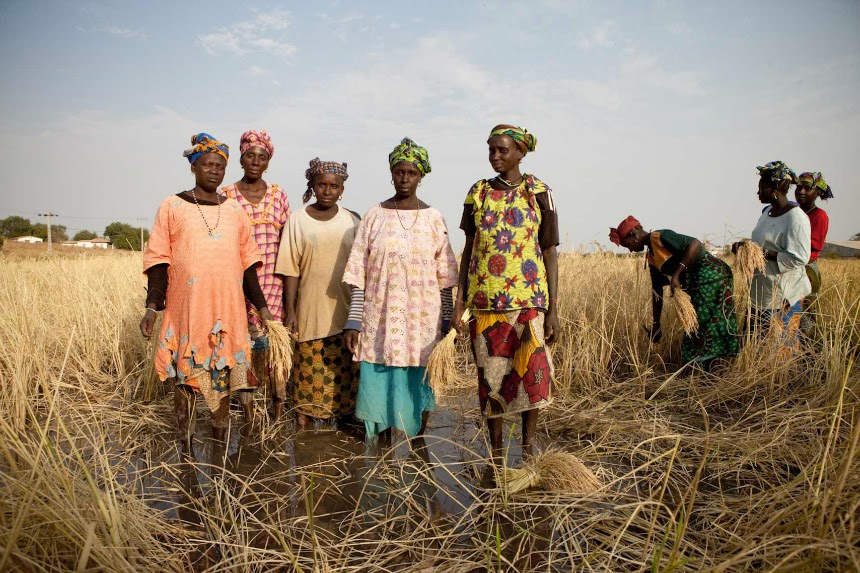
Gambian women in their rice fields in Kaur
Dr. Nwenze, IFAD President
The Gambia is the smallest country in Africa with a total arable land of about 558,000 ha of which 320,000 ha or 57% of that is cropped annually.  The country's economy is agriculture based with the sector contributing approximately 30%  of GDP in 2009 and employing over 70% of Gambians.

With these figures steering Yaya Jammeh straight in the eye, and in spite of his regime's mantra of 'eat what you grow and grow what you eat', he has been investing less than 3% of the budget on the sector since he seized power.  As a signatory to the Maputo Declaration that recommends African countries commit 10% of their budget to agriculture, Jammeh has woefully failed in his commitment to the sector.  Admittedly, the trend has improved from 2.75 to 8% but not before he was literally shamed by the dismal numbers such as spending less on agricultural R&D than any other country in Africa.

Gambia is one of the least food secure countries in Africa, in part because of the lack of coherent and consistent policy measures, a problem cited by the International Fund for Agricultural Development (IFAD) President during Day 1 or a two-day visit to Banjul.  The IFAD President also expressed a degree of angst, predicated by a plea to ensure "that project implementation frameworks are respected in order to ensure that partnerships, particularly in decision making, is highly participatory."

By Day 2, The IFAD President's tone changed to sound like someone cuddling a dictator who stands to threaten the rural economic policy infrastructure through his proposed Food Security Corporation (FSC), using the IFAD-funded $65 million NEMA Project.  As we have said in an early post, and outlined in our open letter to the IFAD President, no national honors and medals conferred on Jammeh's guest can conceal the fact that transferring "all excess agricultural land" to the FSC, as announced by Jammeh is a very bad idea.

To put it bluntly, it is a dangerous idea and should be opposed at every turn.  And to hear the IFAD President say that while attaining self-sufficiency in rice in 18 months is ambitious but achievable is disappointing coming from the head of one of the most respected UN Agencies.  The idea is not a serious one and thus should not have been dignified with an endorsement from IFAD.

It should, therefore, be opposed by all those who continue to have trust in the rural economy, sustained in no small measure, by the hard-working rural women of The Gambia, and men too  The traditional land system which has served the rural population well, is the cornerstone of the rural economy that is being threatened by an inept and corrupt regime.

No excess agricultural land should be deeded to a Corporation thus denying villagers access.  Any fundamental structural change to the traditional tenure system will inevitable reverberate throughout the rural economy, threatening livelihoods of hundreds of thousands of rural women, men and children. IFAD should not be seen to be condoning such an irresponsible policy by an equally irresponsible and idiosyncratic dictator.

As we write, there are 10 highly trained agriculturalists in jail.  They have been arrested and in custody on flimsy charges.  In July, 17 rural women, all from one village, were arrested in their rice farms and charged for planting beyond what the perimeters demarcated by the  local District Tribunal.

The Project Director of NEMA, Momodou Gassama, was dismissed from his job in June only to be quietly reinstated a fortnight ago, in time for Dr. Nwenze's visit.  As soon as he departs, Yaya Jammeh will continue to meddle, not only in project implementation but in what the IFAD President referred to as the "decision making" process.


Thursday, August 21, 2014

FREE THE 17 MBAYEN WOMEN FARMERS

Gambian dictator Jammeh
President of IFAD
As the President of the International Fund for Agricultural Development (IFAD) starts his two-day official visit to The Gambia,  it is only appropriate to bring to the notice of Dr. Kanayo Nwanze and the other development partners the plight of 17 women arrested on 21st July in their fields while cultivating rice in Mbayen, Niamina East in the Central Region of the country.

According to the police commissioner of the jurisdiction, the women were arrested for breaching the order of the district tribunal by planting beyond the boundary demarcated by the tribunal.

The 17 women farmers arrested were : Haddy Mbaye, Fatou Mbaye, Fanta Mbye, Jarra Mbye, Rouhiatou Mbye, Ramaata Mbye, Awa Ceesay,  Jay Mbye, Jainaba Jeng, Huja Mbye, Ada Ceesay, Guma Mbye, Sohna Mbye, Yassin Boye, Aramatta Mbye, Chibu Mbye and Jay Ceesay.

These arrests took place during the holy month of Ramadan, and for this reason 5 of the 17 women were released to allow them to go prepare Iftar for the husbands.  However, there was a catch, the husbands had to trade place with their wives behind bars.  The treatment of these women is both demeaning and medieval, only in Yaya Jammeh's Gambia.that such a ridiculous abuse of power can take place.

IFAD's main mission is focused on small holder agriculture, with women and youth as the main target groups., the very groups that are the victims of the Gambian dictatorships.  Their labor is regularly exploited by using it in Jammeh-owned farms across the country.

We hope the plights of these 17 hard working women farmers are brought to the attention of Yaya Jammeh by the IFAD Mission to The Gambia in addition to the Agriculture 10 who were dismissed and charged under the most suspicious of circumstances.


Wednesday, August 20, 2014

Gambia : Corruption under Jammeh (Babilli Mansa, Nasurul Deen)

Babilli Mansa, Nasurul Deen Jammeh
Official corruption in full display 


Transparency International is nonpartisan nongovernmental organization that started publishing the Corruption Perception Index (CPI) of countries in 1995, a year after Jammeh and his gang seized power in Banjul.  

The first CPI contained only 41 countries, a figure that grew over time to 180 countries.

Gambia was not part of the exercise until 2004 when it was perceived as the 90th most corrupt country out of 145 countries surveyed.   The Jammeh regime was ranked higher than countries like Benin, Mali and Senegal and thus more corrupt but ranked lower and thus less corrupt than Tanzania, Mozambique and Malawi.  

In 2005, Gambia slid to 103rd position out of 153 countries even though more countries were added to the list but still less corrupt than Eritrea, Zambia and Zimbabwe.  Still Senegal, together with Algeria, Malawi and Mozambique, were deemed to be less corrupt. 

From 2006 to 2008, The Gambia saw its ranking plummet from 121 to 143 to 158 while countries like Malawi, Mozambique, Sierra Leone and Liberia and Benin that were more corrupt had improved to position up the scale to become less corrupt than The Gambia.

Something strange and unusual happened in 2009.  The Gambia actually improved its CPI by being ranked 106th out of 180 countries.  That year, The Gambia shared the 106 position with Argentina, Benin and Gabon, ahead of Algeria, Djibouti and Egypt but behind Senegal, Zambia and Madagascar.

In 2010, further improvement in Gambia’s position took place with a ranking of 91 out of 178 countries. In 2011 there was further improvement to 77 place in the scale. 

But in 2012, the level of corruption spiked, relegating The Gambia to 105 position out of 180 countries ahead of Mali, Ethiopia and Niger but behind Senegal, Tanzania and Algeria.

In 2013, Gambia’s position deteriorated further to 127 out of 175 countries, making it less corrupt than Lebanon,  Mali, Madagascar and Cote d’Ivoire but more so than Senegal, Sierra Leone, Togo, Ethiopia, Tanzania and Gabon.

We will allow folks to have the CPI stare you in the face before you decide whether the “soldiers with a difference”, as they called themselves back in 1994, have fulfilled their promise to, at least, reduce the scourge of corruption. 

Even in the absence of CPI during the 30-year administration of Sir Dawda Jawara, it is safe to say that the regime of His Excellency Sheikh Professor Dr. Yahya AJJ Jammeh Nasirul Deen Babilli Mansa.  


Monday, August 18, 2014

FREE THE AGRICULTURE 10

Fafanding Fatajo
The regime's hammer came down hard on ten highly trained and experienced agriculturists whose expertise are needed in an agriculture-based economy.

In July this year, Fafanding Fatajo the Project Manager of FASDEP, Lamin Fatajo Project Coordinator of Rural Finance, Foday Jadama, Regional Director and seven other officers were arrested, dismissed from their jobs and placed in cells for a variety of unsubstantiated allegations.

It is now over 35 days since they have been arrested without charge or bail.   What is so extraordinary about these officials is that some of them are seconded officials from government to United Nations agencies operating in The Gambia.

Kutuba Sanyang, Project Coordinator of the Cowpea project,  Dr. Saikou Sanyang, the Regional Director of the North Bank were also among the ten arrested.

The Gambia is currently faced with serious problems and the agriculture sector is no exception.  The 2014 season is off to a bad start and the agriculture is no exception.  Food deficits have become a permanent fixture because of poor agricultural policies, although inadequate rains has also contributed to the problem.

These officials must be released or charged and taken to court. Their freedom cannot be denied because it is wish of the dictatorship.

FREE THE AGRICULTURE 10